
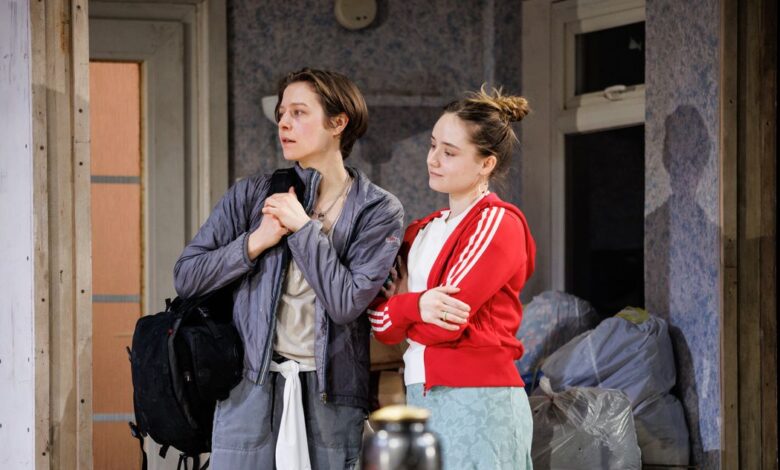

Emma D’Arcy and Ruby Stokes in The Other Place at the Shed.
Photo: Maria Baranova
If you’ve been a committed theatergoer over the past year in New York or you’ve just gotten into light time travel, you might have collected the set of Sophocles’ three Theban Plays modernized in a kaleidoscope of genres. We’ve seen Robert Icke’s Oedipus as a political thriller on Broadway last fall, Shayok Misha Chowdhury’s revival of the choral Gospel at Colonus at Little Island in the summer (if you missed that, I recommend a tape of the 1985 production on YouTube), and now, Alexander Zeldin’s The Other Place at the Shed, a version of Antigone turned into a bourgeois family drama. (We’ll get another look at Antigone soon at the Public.) Sophocles wrote these works over the course of decades, out of chronological order, and with more than few inconsistencies, but they serve one another well as a unit. The brutal momentum of Oedipus crashes into the soul-searching of Colonus, allowing for the catharsis of Antigone. Shorn of context, they can feel fragmentary on their own, dance steps that need a few more beats to complete a movement.
At least that’s how it felt to watch Zeldin’s revision of Antigone, which moves things from Thebes to a home under renovation somewhere outside London. At 80 minutes, it presents a slim, incompletely cutting family reckoning, one that spills a little blood but doesn’t sever any arteries. Emma D’Arcy (most familiar to us Americans as a queen on House of the Dragon or for their taste in negronis) is Annie, a wayward niece who suddenly returns to her family’s estate after her uptight uncle, Chris (Tobias Menzies, the knifelike lines in his jaw well utilized here), announces his plans to scatter the ashes of Annie’s father, Adam, which have been sitting around in an urn for years. Annie objects ferociously, insisting the ashes should stay at home, stirring up the currents of familial resentment and dragging her sister, peacemaking Issy (Ruby Stokes), into them.
Zeldin, in your program, insists he intends The Other Place to stand independent of its source. But as in the case of many a work whose name director (who is, as my colleague Sara Holdren has pointed out, usually male) asks the daring question, What if this classic had big glass sliding doors?, it’s impossible to ignore the shadow presence of the original. Characters tend to move around in a set pattern as if being pulled by magnets, which is fine for the ritualistic structure of ancient texts but difficult to buy when a sheen of psychological realism is imposed. Annie’s insistence on proper burial rights — so pressing in the context of Sophocles when Antigone attempts to bury her brother Polynices — doesn’t register with the same weight in a contemporary setting, and it puts us at immediate odds with the character. Why would this itinerant progressive backpacking type care so much about her dad’s ashes, except that she’s a faux-Antigone and we need her to? Grief can grip you with strong, irrational impulses, but because there’s no disrespect for the dead in spreading someone’s ashes in a nice little ceremony, Annie’s objections leave you thinking she is less righteous than petulant. And what was the nature of her father’s death that has made discussion of him so taboo? Perhaps for the sake of universality, Zeldin keeps Adam’s past vague, implying he was a tortured, unstable patriarch, not someone who imploded his family name with a transgression on the scale of Oedipus’s own. It’s the wrong approach. Any version of Antigone needs to be powered by the overwhelming force of something big and dark, as if trying to hold back a reservoir of pain on the scale of the Hoover Dam. Instead, late in the evening, Zeldin gives the family a separate revelation. The luridness of that turn, which made some in the audience around me gasp, is one issue, but it’s more that it unsettles the structure of the piece. We thought were in the shadow of one kind of grief, and it’s usurped by another, more pressing one, with little time to process it. Instead of accumulating force, The Other Place buckles and swerves.
Zeldin directs that drama, too, with a confrontational insistence it doesn’t earn, underlining a shock that could stand well enough on its own. Three years ago, I was impressed by his brief but fierce staging of the precarity of homelessness in Love when it came to the Park Avenue Armory; the play ended with the shattering of the fourth wall as a dying woman begged for help from the audience around her, making them literally reach out and hold her up. But when Zeldin goes for a similar gesture here — Menzies, in this case, turning to the audience and insisting, “Don’t look at me!” at the height of his angst — it rings hollow. Perhaps that’s because the characters in The Other Place don’t have much space to breathe before we see them as figures in an archetypal drama. We’re not unsettled by the sense that they might turn and look at us because they’ve never been deeply hidden within their own context. Menzies is an ever-reliable ace, especially when playing a man you do not trust wearing a knee-length coat, but he can go only so far in rendering Chris as more than a Creon type. When Menzies explores his character’s infantile humor, he’s most compelling, suddenly and unsettlingly boyish, but Zeldin doesn’t allow him much time for that.
The ensemble in general labors within both a thin range and striking but familiar staging gestures. Designer Rosanna Vize (of Vanya) has delivered an antiseptic home of a set for The Other Place — with the requisite big glass doors at its center reflecting the audience’s faces back at us because, sure, we’re implicated in all this — and dressed the cast in sleek pseudo-casual garb. (Stokes’s Issy wears the top half of a tracksuit because in any British drama, someone must.) Yannis Philippakis’s score provides the now-familiar atavistic sound of creeping dread, a feeling magnified by the way Josh Anio Grigg’s eerily crisp sound design seems to capture every actor’s breath. The craftwork is all topflight and probably expensive, yet it chokes the performances rather than revealing them. I wanted everyone to get out from under the portentousness of doing something grand and important and just live. But instead, there’s Jerry Killick laboring under the terminally unfunny assignment of playing Chris’s annoying co-worker Terry (a Tiresias analogue, I guess?); Lorna Brown providing what warmth she can as Chris’s unwisely devoted wife, Erica; and Lee Braithwaite as a teenager uncharitably depicted as obsessed with their screens. D’Arcy is least well served, to the point that it surprised me to learn Zeldin had conceived the role of Annie for them specifically. It’s not that you can’t tell they’re an exciting stage performer — in some scenes, D’Arcy plays Annie with a compelling tetchiness, as though the prodigal daughter were trying to slough off her own skin — but it’s like they brought in an accumulation of ideas about who Annie may be and never fully resolved them with the director. A surprise, given that the two of them enjoyed acclaim for The Other Place when it ran in London. Perhaps some things were lost in restaging across the Atlantic or not meant for us to understand. In any case, we New Yorkers are left grasping in the dark to better understand Annie, or Antigone, whoever she is.
The Other Place is at the Shed through March 1.
Source link