
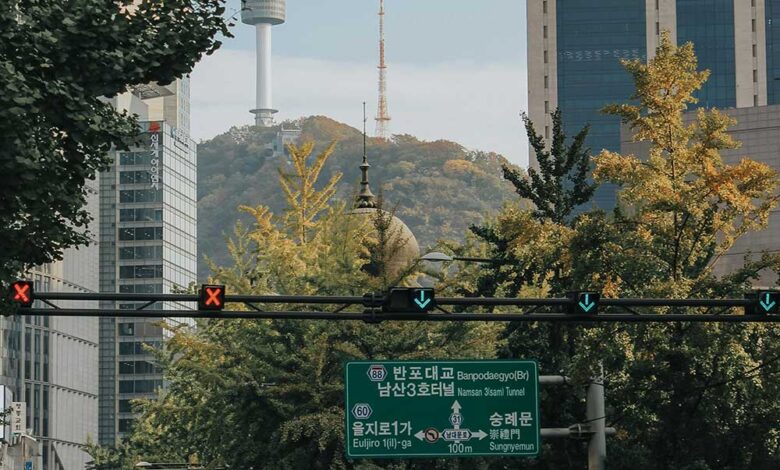

Getting Around Seoul
I found Korea’s public transportation system a little perplexing on my first visit.
It’s clean, efficient and well designed – except if you’re a foreigner visiting.
In my First Timer’s Guide to Korea, I recommended taking taxis to get around, especially if you’re traveling with a group.
But I know some people prefer to use public transportation and Seoul’s buses and subways aren’t bad.
Here’s my tips for getting around Seoul on public transit:
ADVERTISEMENT
By Subway
Seoul has a well-run, clean and efficient subway network. To use it, you’ll need to first purchase a transit card.
There are 2 main options:
- T-money card: a reloadable, pay-as-you-go card
- Climate Card: an unlimited, duration-based cards for short-term periods (1-7 days) or 30-day passes
I’ve only ever used a T-money card, but I might try a Climate card on my next trip..
ADVERTISEMENT
Why Public Transportation in Seoul is a Little Inconvenient
Unlike NYC, you can’t directly pay for public transit with a credit card. You also can’t add the T-money card to your mobile wallet and top-up with mobile pay.
In Korea, you’ll need to have a physical transit card in hand, and use it to tap to board and tap to exit, so don’t lose the card!
I’m always so frazzled using foreign public transportation that I’ve misplaced and lost my T-money card a couple times, ugh.
In the subway, you can only buy single-use subway tickets. These require a ₩500 deposit per card, so you have to return the card at the destination’s Deposit Refund Device’ machine to get your ₩500 back.
It’s very annoying so instead, you should get a T-money card which is like a regular transit card that you can reload with money.
ADVERTISEMENT
How to Get a T-Money Card
You can’t buy a T-money card in the subway station itself.
Instead, you can buy these at convenience stores (GS25, CU, 7-Eleven). There are convenience stores on most blocks so you shouldn’t have to walk far, but it’s so strange to me that the subway doesn’t sell reloadable subway cards!
A T-money card costs about ~₩3,000–₩5,000 for the card itself. You can add whatever amount you want to the card on top of that, but topping up the card can only be done with cash.
Convenience stores themselves accept credit cards, you just can’t top up a T-money card with a credit card. (I believe it’s because they consider the cards like a cash equivalent, so using a credit card to top up would be considered a cash advance)
I find that it’s better to add more money than you think, usually around ₩15,000 – ₩20,000 each time. If you have extra funds on a T-money card, you can always use it on convenience store purchases.
ADVERTISEMENT
Topping Up a T-Money Card
You can reload your T-money card either at convenience stores, or in the subway, using one of the kiosk machines.
Update: As of September 2025, the government announced it’s adding credit card top-ups to select Seoul subway stations, so that you can top up the T-money card using your credit card!
When I visited in December 2025, I didn’t see this option but I think it’s taking time to roll-out across the city. So, just have cash on hand to be safe!
One final thing to note – make sure to double check your subway’s direction before you swipe your metro card to enter the turnstiles.
I’ve made the mistake of hopping on the train in the wrong direction a couple times and it’s a bit of a mess – it already charged your card, it triggers a loud error noise from the machine and it doesn’t understand when you try to re-enter on the right direction, so it’s a bit of a mess.. oops.
ADVERTISEMENT
By Bus
I actually love Seoul’s bus network, more than the subway (kind of a hot take, I guess).
Depending on where you’re going, the bus can actually be more convenient.
But, it typically takes a little longer because Seoul, like most Asian cities, has pretty congested traffic.
I find Seoul’s bus system very easy to navigate. The buses come quickly and there’s free wifi on the bus itself. Transfers between buses and subways are free within a certain distance.
ADVERTISEMENT
Fares are distance based and also depend on the type of bus you’re riding, but range from ₩1,200 to ₩3,000 ($0.85–$2.15 USD) per ride with a transportation card.
Cash is not accepted, you must use either a T-money or Climate card.
- Local Buses (Green): ₩1,200 (Adult), ₩600 (Teen), ₩400 (Child)
- Local Buses (Blue): ₩1,500 (Adult), ₩900 (Teen), ₩550 (Child)
- Red Buses (Rapid/Express): ₩3,000 (Adult), ₩1,700 (Teen), ₩1,500 (Child)
- Owl Buses (Late Night): ₩2,500 (Adult)
Remember to both tap your transit card both on boarding and exiting! If you forget to tap off, it’ll automatically charge you the highest rate.
All of that to say, Seoul’s public transport can be a bit tedious for a first time visitor and is why I recommend Uber for people visiting as a couple, family or group 🙂
ADVERTISEMENT
Visiting Korea – Travel Checklist
Flights | Direct flights from NYC to Seoul can be limited, but I like budget Korean airline Air Premia. I also recommend taking direct flights to Japan (more flight options), then making a short stopover tip to Seoul. Check here for flight deals here and set an alert for your dates.
Hotels | Seoul is a large city, with lots of great neighborhoods for sightseeing, shopping and activities. I recommend staying North of the Han River in Myeongdong if you primarily want to sightsee and South of the river in Gangnam if your priority is skincare, shopping or beauty treatments.
Check here for deals on Seoul hotels and definitely book in advance if you’re traveling in the spring or fall.
E-Sim | Download a couple Korea-specific apps before your trip, like Naver Maps and Kakao Talk as Google Maps isn’t really up to date in Seoul. I highly recommend getting an e-sim so you can stay connected, translate menus and signs and hail a taxi. Jetpac offers affordable esims with daily packages as low as $1/ day.
Insurance | Lastly, be sure to visit Korea with travel insurance.
Whether you get injured and need to be hospitalized, your phone gets stolen, or a flight delay leaves you with nothing but the clothes on your back, travel insurance will help when you need it most.
Flight delays and lost baggage are happening frequently this summer! Get a quote for your trip here.
You Might Also Enjoy:
Seoul Vacation Planning
A First Timer’s Guide to Seoul: All the Essentials Tips You Should Know
Where to Stay in Seoul (tips for first time visitors)
Seoul in Style: The Perfect 5 Day Girl’s Trip Itinerary
How to Get Around Seoul using Public Transportation
Follow me @Sher She Goes on