
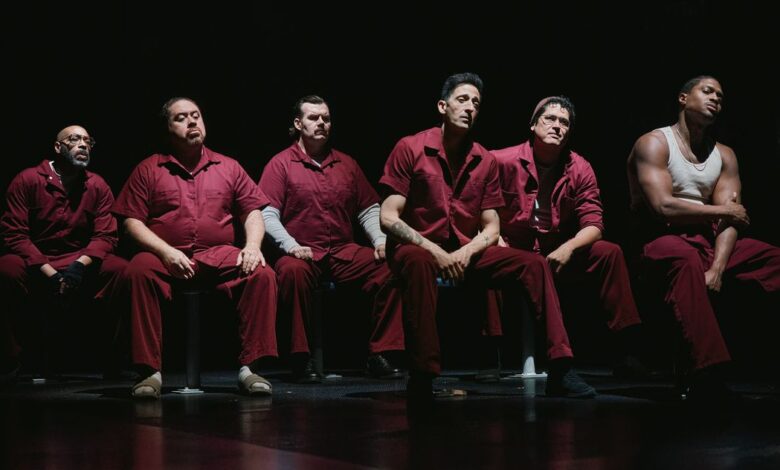

From The Fear of 13, at the James Earl Jones Theatre.
Photo: Emilio Madrid
“The more ludicrous your stories are,” a prison volunteer tells the death row inmate Nick Yarris, “the more I find out they’re true.” The volunteer, named Jacki and played with warm restraint by Tessa Thompson, has been slowly developing a friendship with Yarris, a mercurial but undeniably charismatic character played by Adrien Brody, your go-to actor for any slight man with a loping, unsteady energy. Yarris, in their early interviews, has relayed tales of the through-the-looking-glass social dynamics of life in prison, as well as the stranger-than-fiction story of his own escape attempt, in which he used a credit card from a stolen fur coat to buy a plane ticket to Florida (and still took a moment to tip at the coat check). The fact that Jacki has checked up on Yarris’s stories is a sign of her growing investment in his welfare, and it’s also an act that crosses a line. He freaks out, worried she’s dug into other aspects of his past as well as his conviction, which he does not want to discuss. He thinks Jacki is supposed to be uncritical, here to provide solace. She has, without realizing it, shifted into the position of a reporter and an advocate.
There’s a distinction between those two roles, of simply listening versus verifying and acting, but a crucial one, and like Jacki herself, The Fear of 13 tends to muddy it. Lindsey Ferrentino’s play is based on David Singleton’s slim documentary of the same name, which is itself built around interviews with Yarris. He spent 22 years in prison on a conviction for murder, rape, and abduction, before—in what is perhaps a spoiler, though the production’s own marketing brings it up—being exonerated in 2003 through DNA testing, becoming the 13th person on death row to be released thus. Yarris, who gives lectures about his experience, now appears in the audience some nights, and Ferrentino has corresponded with him as she’s expanded the documentary for the stage. Her script, directed with a too-light touch by David Cromer (replacing Justin Martin, who helmed a London production), re-creates many anecdotes from the documentary—the escape attempt, Yarris’s description of his teen experiences with meth addiction and petty crime, his railroading by an uncaring judicial system—with respectful reverence. It’s a vehicle for Brody to show off his wiry garrulousness and for us to admire the literary quality of Yarris’s own storytelling. He’s read a lot in prison, and he charms Jacki initially with a joke about David Copperfield by way of The Catcher in the Rye.
But a play isn’t an interview, nor is it a monologue. Any reporter will tell you it’s hard to write a satisfying profile without some secondary sources. In hewing close to the format of that documentary, Ferrentino doesn’t have much space to fill in a clearer sense of Yarris’s universe beyond what he (in this case Brody-as-Yarris) is telling us, and there’s little grounding for his admittedly quite enthralling tales. For a play ostensibly about the huge broken thing that is America’s prison-industrial complex, The Fear of 13 spends little time thinking about larger systems, or even raging against the machine As a playwright, Ferrentino tends to locate her work around charged issues—a school shooting in This Flat Earth, PTSD in Ugly Lies the Bone, and (vaguely) wealth inequality in the musical The Queen of Versailles (her other documentary adaptation of this season). She’s coming up with careful conclusions. Yes, the injustice done to Yarris was unjust. But to what end, for whose benefit, or to assuage what fears? We get brief, broad portraits of inept defense attorneys, cruel guards, and uncaring judges from members of the play’s ensemble. (The great Eddie Cooper, of the late lamented Dead Outlaw, is memorable as a judge who just wants to eat his sandwich.) There’s a chilling sense, in the way Yarris describes his youth, that prosecutors were happy to pass judgment on a life for the sake of efficiency, but it’s not a notion that Ferrentino lingers on. She turns to gentler platitudes. We keep hearing Yarris’s descriptions of the inmates around him. Sometimes, they sing, with moving harmony. Jacki spends less time with them—in an awkward line, she admits to becoming fixated on Yarris while ignoring the Black men around him—but her focus need not be the play’s. Given the possibilities of theater, might we also get to hear from them directly?
It’s through Jacki that we get to know Yarris and see much of the play, and she proves to be a frustrating and fascinating lens. The woman she’s based on is real, a volunteer who—and this is perhaps another spoiler, though one again disclosed elsewhere—married Yarris as the two of them fought to overturn his conviction. The real Jacki is held at a distance—Thompson “never met the inspiration for her character,” according to Vogue, “because Yarris strove to protect her identity when filming the documentary.” That gives Ferrentino, Cromer, and Thompson some imaginative latitude, opening a lot of potentially productive dramatic questions. I am very curious about the life of someone drawn repeatedly toward what appears to be a hopeless case, who enters the dynamic from the position of offering a condemned man some human empathy, and then becomes converted to championing him. And Thompson is a compelling stage presence, the kind of actor who, even in the act of listening, seems to be working out a thought behind her eyes. (It’s her Broadway debut, but she feels like a veteran, maybe because she was so good in the overlooked film Hedda.) In a striking scene, Cromer and Ferrentino conjure a glimpse of Jacki’s home life, when, as she calls Yarris in jail, a detailed and naturalistic rendering of her apartment opens up inside vast and dark expanse that makes up the rest of Arnulfo Maldonado’s set. The image, of freedom and detail and normality contrasted with the infinity of waiting, sticks with you (even if it’s also a gesture that makes you think about Cromer’s Our Town). How distant, to a man in confinement, it must feel to hear someone unpack groceries, water their plants, and laze on a couch in front of Seinfeld.
But The Fear of 13 doesn’t linger on Jacki. Ferrentino writes her in fairly rote terms as a bleeding-heart doctoral student in poetry, and has her politely recede as the play goes on. Instead The Fear of 13 is almost singularly about Yarris, which means that it’s also about Brody himself. As evidenced by his recent Oscar win and the press he did along the way—including a profile for this magazine while performing The Fear of 13 in London—he has an abiding interest in contradictory and challenging but righteous men, which makes someone like Yarris an obvious draw for him. In his performance, Brody relishes the act of digging into a Philly accent, and of capturing the back-broken physical bearing of a condemned man. That enthusiasm is in many ways valuable. Even in the harshest descriptions of the violence and almost unbelievably cruel twists of fate that Yarris endured (the DNA testing keeps getting accidentally mucked up), Brody lends him a vital indomitable spark. But he’s so enamored with that bravado, that of his character and his own, that he only glancingly finds a dimension beyond it. He was, as is the play itself, repeating a good story but not providing deeper insight, giving us a mythology without a deeper sense of a man.
The Fear of 13 is at the James Earl Jones Theatre.
Source link